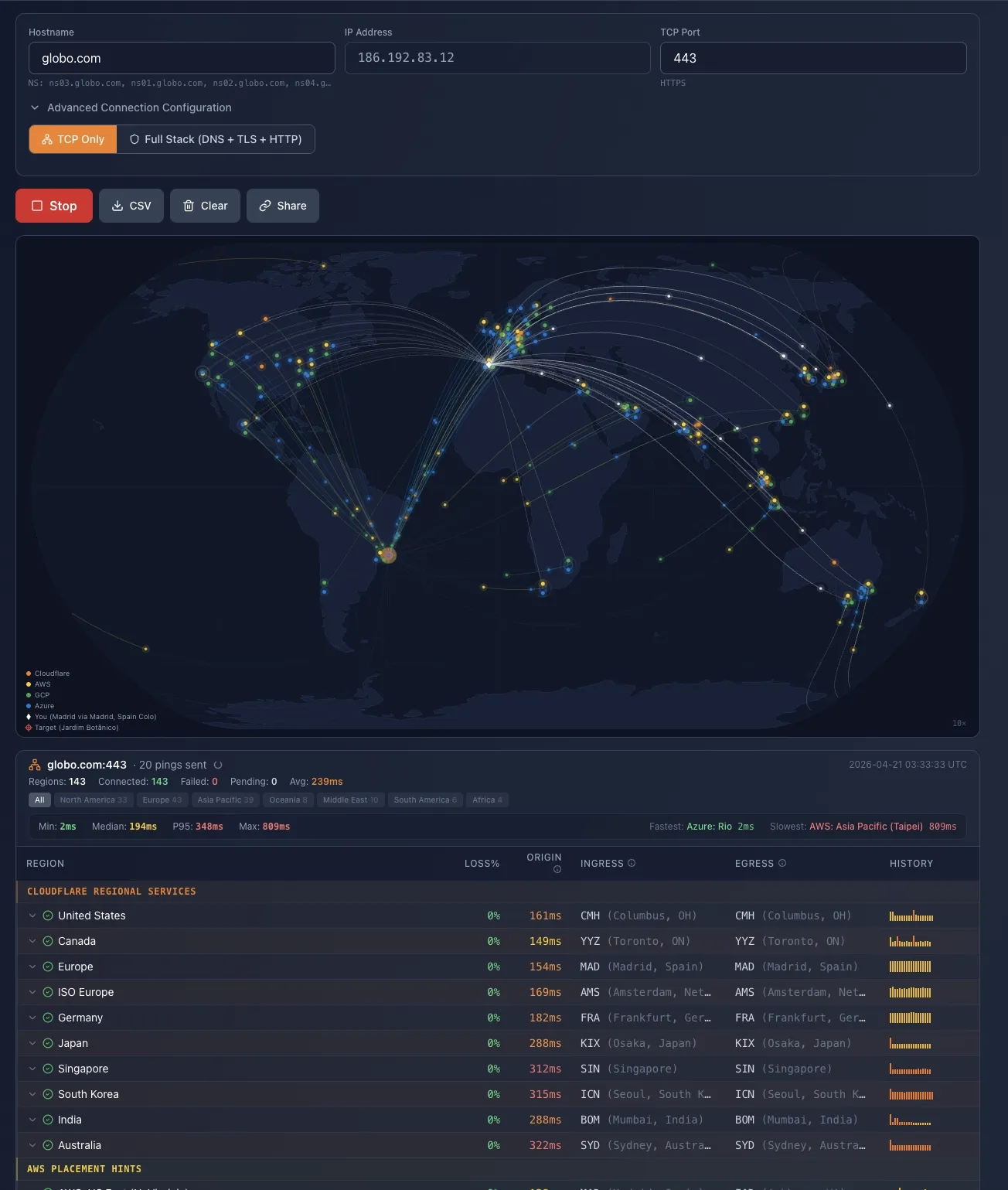
I built healthchecks.ross.gg as an vibecoding experiment to test the TCP capabilities of Cloudflare workers. It sends a TCP SYN ping to every colo that I have access to in my personal account. https://ping.pe/ is useful for troubleshooting with ICMP globally, and this tool complements ping.pe with TCP pings from “all” Cloudflare colos. It’s possible that this could help you identify regional outages with more granularity. Source is on GitHub as global-healthchecks.
Warning: Targets must be outside Cloudflare’s network (AS13335). Connections to Cloudflare-proxied hosts are blocked, and the test button will be disabled. If your hostname resolves to a proxied DNS record (orange-cloud), supply the origin IP or un-proxied CNAME target directly instead of the proxied hostname. Otherwise the worker would get an Error 1014.
Table of contents
Open Table of contents
Healthchecks
Why You Might Use This
- “Is my origin up from $REGION?”: TLS cert renewals, firewall changes, and BGP weirdness often only break from one region. Hitting the host from 143 colos at once surfaces it in seconds.
- “Is the slowness the network or the app?”: Timings of different phases (TCP / TLS / HTTP) tell you whether your latency budget is being eaten by the handshake, the cipher negotiation, or the application itself.
- “Does my cipher policy actually work globally?”: Pin a min/max TLS version or a specific cipher list and confirm the server negotiates what you expect globally. This obviates the need for spinning up a vps in the right region just to run
openssl s_client.
How It Works
The tool performs TCP pings from 143 Cloudflare Worker placements deployed across the globe, but those 143 placements only land on roughly ~62 unique Cloudflare colos. Many cloud regions share the same nearest Cloudflare data center: AWS Ireland, AWS London, Azure London, and Azure Cardiff all egress through LHR. AWS Bahrain, AWS UAE, GCP Doha, GCP Dammam, GCP/Azure Mumbai, and GCP Tel Aviv all egress through BOM. Each placement opens a raw TCP socket to your target host:port and measures the round-trip latency from that location. Unlike ICMP ping, a TCP ping completes the three-way handshake (SYN → SYN-ACK → ACK) to verify the port is actually accepting connections. Results show which data center handled the request and how long the connection took.
Two Placement Strategies
The 143 endpoints use two different Cloudflare mechanisms to control where the Worker executes:
| Strategy | Count | Configured On | Behavior | Region Codes |
|---|---|---|---|---|
| Regional Services | 10 | DNS record | Worker is guaranteed to run inside the target region. Ingress and egress are the same colo. | us, eu, jp, etc. |
| Region Placement | 133 | Worker config | Request hits your nearest edge, then is forwarded to a colo near the cloud provider region. | aws:us-east-1, gcp:europe-west1, etc. |
Ingress Colo is the data center that first received your request. Egress Colo is where the Worker actually executed and ran the TCP test. This is derived from the cf-placement response header. These colos will be the same with Regional Services and may differ for Region Placement.
Note: Connections to targets on Cloudflare’s network (AS13335) are blocked for security reasons. The test button will be disabled for any target on AS13335.
Test Modes & OSI Layers
The tool supports two testing modes. TCP Only opens a raw socket at the Transport Layer (L4) and measures the three-way handshake. Full Stack builds on top of that: after TCP, it establishes a TLS session with configurable version and cipher constraints (L5/L6), then optionally sends an HTTP request and measures time to first byte (L7). Each phase is timed independently.
| Action | OSI Layer | Analogy | Measured |
|---|---|---|---|
| TCP three-way handshake | Layer 4: Transport | Dialing the phone | TCP ms |
| TLS handshake & session establishment | Layer 5: Session | Starting the meeting, agreeing on terms | TLS ms |
| Cipher selection & encryption | Layer 6: Presentation | Choosing the translator | TLS ms |
| HTTP request & time to first byte | Layer 7: Application | Having the conversation | TTFB |
In a typical browser or curl request, TLS session setup happens automatically inside the networking stack, and the caller never touches Layer 5 or 6 directly. This tool is different: the Worker uses node:tls to act as a Session Manager, explicitly controlling the TLS handshake parameters (min/max version, cipher suites, SNI) that normally live below the application’s reach. Because you’re choosing which ciphers to offer and measuring handshake latency and protocol compatibility, you operate at Layer 5-6, managing the dialogue between client and server, not just consuming it.
Color Thresholds
| Color | Latency |
|---|---|
| 🟢 Green | < 100ms |
| 🟡 Yellow | 100–250ms |
| 🔴 Red | > 250ms |
Powered by Cloudflare Workers Sockets API. Try it at healthchecks.ross.gg or read the source on Github as global-healthchecks.